
Advantage
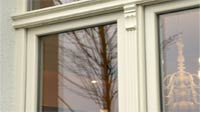
Attractive Appeareance
UPVC windows and doors are built with smooth surfaces and properly welded corners. The profile color will not turn yellow or fade after a few years of use. Frequent cleaning is possible without any repainting throughout the useful life of the frame, thus the maintenance cost is low compared to wood
Excellent Heat Insulation
According to a recent survey, 37% of household energy is generally lost through windows. Proper selection of windows and glass would enormously cut down this energy loss. Our UPVC systems with 20mm insulated glass thickness, conducts heat at the K value of 1.65W/m2K, compared with 7.50W/m2K for normal aluminum window frames.
Corrosion Resistance
In cities with high pollution levels UPVC can withstand corrosion caused by such conditions. Even beach-side residencies which are subjet to humid weather, our PVC is still resistant to corrosion and damage.
Environmentally Friendly
Our UPVC systems are made from ecologically friendly materials in terms of less pollutant emissions than wood and aluminum. Polymer is recyclable, and so there is no lost material as all waste goes back into the recycling process to manufacturer other products.
uPVC windows have a number of qualities that are being increasingly recognized. The frames are low maintenance as they are tough and durable, do not rot, and do not require painting overtime. The frames are also non-conductive, meaning they do not transfer heat and therefore will not influence the internal temperature of a building. The combination of uPVC frames and double glazing means maximum energy efficiency is produced.
While PVC is the material most widely used for windows across Europe, they are still a relatively small, but growing, part of the Australian windows market. According to local uPVC windows fabricators, the increasing demand is due to home owners’ and building designers’ desire to limit the environmental impact of their homes and buildings through limiting carbon emissions.
Excellent Energy Savings
PVC windows cut down energy loss far better than any aluminum window. This is because PVC windows are made with hollow sections (a.k.a. multi-chamber system) using an extrusion process, which lowers external heat dispersion into the inner area. The profile wall thickness is 2.8 - 2.9 millimeters. (Polymer material is a bad conductor, therefore heat compensation is achieved with this wall thickness.)

Excellent Water Resistance
PVC systems employ a corner welding process to ensure that the window or door corner is completely welded into a single structure; therefore, water is unable to pass through the welded joint. Additionally a double layer of TPE (thermoplastic elastomer) rubber gasket is placed around the sash and the frame to efficiently seal the gap.
Excellent Sound Proofing
PVC is fully self extinguishing against fire. Polymer, the material that our PVC windows and doors are made from, is noncombustible, due to its high chlorine concentration and associated compounds. Additionally, our PVC systems are manufactured under the DIN-16830 standard, thus guaranteeing your safety.
Excellent Weather Resistance
PVC windows consist of Polyvinyl-Chloride, Stabilizer, Titanium Dioxide which are able to withstand various kinds of weather conditions, including ultraviolet rays to help protect the frame structure from expanding and contracting. Our systems are able to withstand high surface temperatures of up to 82 degrees centigrade without defects. This means that long-term sunny conditions will not cause the profile structure to break or deteriorate in quality, throughout its life-time.
Low maintenance
White or coloured uPVC window frames don’t need painting or sealing, significantly reducing maintenance over their life time. They are easily cleaned with water and detergent.
Tough and durable
uPVC is a very durable material used in water and sewer pipes for at least 100 years. Vinyl windows are so durable that the vast majority of them installed over the past 25 years are still in use. Good quality uPVC windows and doors are tested for ultra violet resistance to ensure they won’t fade in the harsh Australian sun.
Rot resistant
uPVC does not rot, and is resistant to corrosion.
Thermal comfort
Unlike metals, uPVC is non-conductive, meaning its use in window frames does not transfer heat and therefore contributes to a more consistent internal temperature in a building. The combination of uPVC frames and double glazing makes for highly energy efficient windows.
Openable Tilt and Turn
uPVC window systems allow opening in two directions to enhance the ability of taking advantage of natural, cross ventilation.
Acoustic insulation
Double-glazed uPVC windows and doors are able to cut down noise by as much as 70%.
Resistant to salt erosion
uPVC is resistant to corrosion caused by salt-laden air making them ideal for coastal properties.
Bushfire performance
Double glazed uPVC windows can be used in Australia in areas where risk is zoned as Bushfire Attack Level 29kW/m2 (BAL 29). Some uPVC windows have been tested to withstand BAL 40.
High security
UPVC windows incorporate multi locking systems providing a high level of security for homes or businesses. Most UPVC window locking systems lock at multiple points all around the sash and frame.
Recyclable
UPVC can be recycled as often as 10 times. Where they have been commonly used for the past 30 years, such as in Europe, uPVC windows and doors can be, and are, recycled at the end of life. Although very little end of life uPVC windows are presently available for recycling in India, Indian industry programs are committed to keeping UPVC out of landfills, putting it back into new products. The off-cuts from UPVC window fabrication are already being collected in some states for recycling.
Copyright © 2016 Designed by Shilpi Singh. All rights reserved.